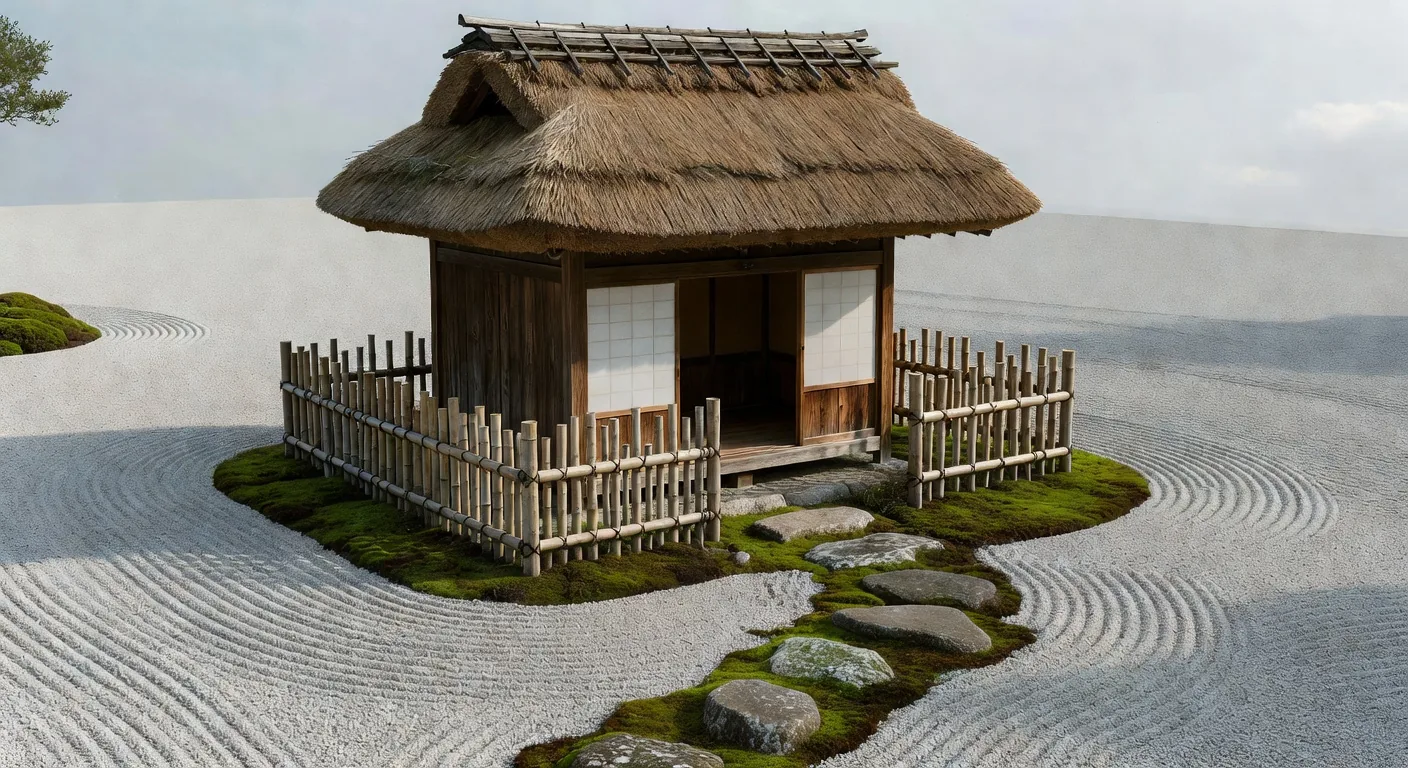
Sacred Spaces of Tea
Chashitsu — The Way of Tea
Where simplicity, impermanence, and beauty converge in the spirit of wabi-sabi
Where simplicity, impermanence, and beauty converge in the spirit of wabi-sabi
Introduction
The chashitsu — the Japanese tea house — is perhaps the most concentrated expression of Japanese aesthetic philosophy in architectural form. Born from the tea ceremony tradition of the 16th century, these diminutive structures embody the concept of wabi: a beauty found in rusticity, simplicity, and the appreciation of impermanence.
Unlike grand palace architecture or imposing samurai compounds, the tea house deliberately embraces smallness. With its low entrance that forces guests to bow, its unadorned earthen walls, and its rough-hewn wooden elements, the chashitsu creates a space apart from the world — a place where rank dissolves and the act of preparing tea becomes ceremony.
"The tea room is made for the tea master, not the tea master for the tea room."
— Kakuzo Okakura
Architecture
Every element of the chashitsu is intentional. From the humble crawl entrance to the precisely proportioned tokonoma alcove, each component serves the spiritual and social goals of the tea ceremony.
The most distinctive feature: a square opening approximately 66cm high. All guests must bow and crawl to enter, equalising social rank and marking a transition from the outer world. Warriors left their swords outside.
A recessed alcove housing a hanging scroll and seasonal flower arrangement. The tokonoma is the spiritual focal point of the tea room, its contents changed to reflect the season, the occasion, and the host's aesthetic vision.
Tatami mats define the room's spatial logic and ritual geography. The position of the hearth within the tatami grid determines the flow of the ceremony, guest seating, and the host's choreographed movements.
The garden path established to the tea house is as important as the structure itself. The roji guides guests through a composed landscape of moss, stone, and filtered light, inducing meditative calm before the ceremony begins.
Irregularly placed windows of varying sizes are a hallmark of tea house design. Each opening frames a deliberate view of the garden, flooding the interior with soft, diffused natural light throughout the day.
The sunken winter hearth (ro) or portable summer brazier (furo) is the functional heart of the ceremony. The sound of boiling water — likened to wind in pine trees — is itself considered part of the tea experience.
Legacy
The great tea masters of Japan's Azuchi-Momoyama period were visionary architects whose designs shaped Japanese aesthetics for four centuries. Each developed a distinct philosophy that transformed the act of drinking tea into a comprehensive worldview.
The supreme master of the tea ceremony, Rikyu refined the concept of wabi-cha — tea in the spirit of poverty and simplicity. His 2-mat Taian tea room at Myōki-an temple (a National Treasure) defined the aesthetic of restrained beauty. He rejected ostentatious decoration in favour of worn, humble materials and compressed intimacy.
Rikyu's most celebrated student, Oribe developed a bold, idiosyncratic aesthetic embracing asymmetry and unconventional angles. His tea houses incorporated distorted proportions and unexpected structural elements, creating spaces of dynamic tension. The "Oribe style" influenced pottery, gardens, and architecture throughout the Edo period.
Where Rikyu embraced raw rusticity, Enshu brought refined elegance called kirei-sabi — beautiful desolation. A garden designer of equal brilliance, Enshu's tea rooms integrated architectural space and garden composition into unified aesthetic experiences, bridging austere wabi tradition with courtly refinement.
The Approach
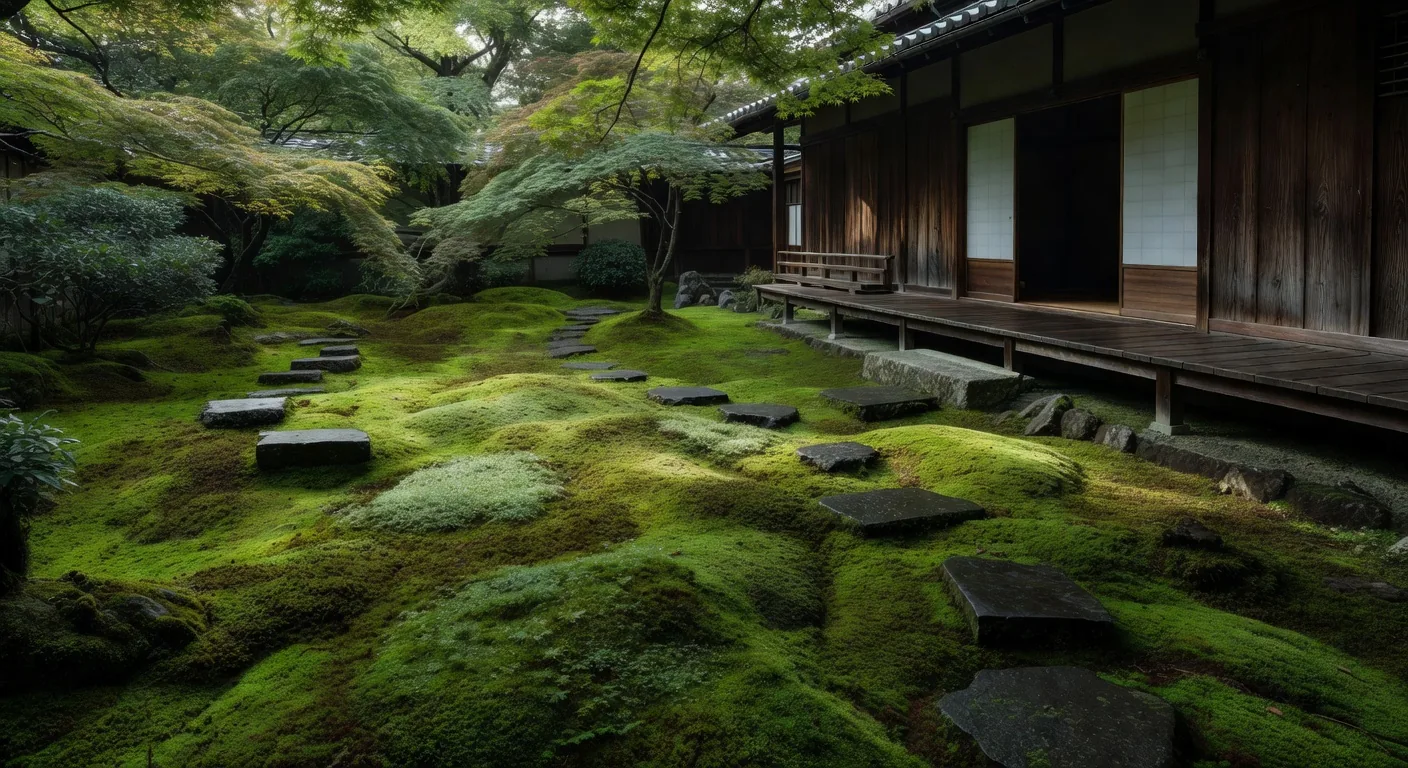
The roji — literally "dewy ground" — is the garden path separating the outer world from the inner sanctum of the tea room. Its design is one of the most sophisticated expressions of Japanese garden art, functioning as a gradual transition between ordinary consciousness and the heightened awareness the ceremony demands.
The roji typically unfolds in two phases: an outer garden of relative openness, and an inner garden of increasing intimacy. A waiting bench marks the transition, where guests pause and compose themselves.
Philosophy
The tea house is the physical embodiment of wabi-sabi, the Japanese worldview centred on accepting transience and imperfection. This is not pessimism, but a profound attentiveness to the beauty of things as they are.
Deliberate imbalance and irregularity reflect the natural world. Perfect symmetry is seen as artificial; asymmetry captures the vitality and spontaneity of living forms.
The elimination of clutter reveals the essential nature of things. In the tea room, only what is necessary remains, and each object is chosen with extraordinary care.
Bare materials — unplastered earth, rough timber, worn stone — are preferred over polished surfaces. Age and weathering are signs of depth and experience, not failure.
An atmosphere of deep quiet pervades the tea room. The silence is productive — filled with awareness of breath, the sound of simmering water, the movement of steam rising.
The tea room exists outside the ordinary world. Social rank, wealth, and ambition are checked at the nijiriguchi. Inside, only the present moment and the act of tea matter.
"In the tea room it is left for each guest in imagination to complete the total effect in relation to himself. Since Zen has dealt with the question of self-realisation, Teaism is akin to Zen."— Kakuzo Okakura, The Book of Tea (1906)
The tea house does not seek to impress. Its power lies in its willingness to efface itself — to become a container for experience rather than an object of admiration. The roughened post, the uneven wall, the single wild flower in the tokonoma speak more eloquently than marble ever could. Each imperfection is a reminder that beauty lives in the fleeting, not the permanent.
Practice
The architecture of the tea house cannot be understood apart from the ceremony it hosts. Every dimension, threshold, and surface is calibrated to the movements, sightlines, and sensory experience of chado — the Way of Tea.
Spatial Types
Tea rooms are classified by the number of tatami mats they contain, each configuration creating a distinct spatial atmosphere, ritual geography, and social dynamic.
The smallest formal tea space, typically 2 mats plus one daime mat (three-quarter size), associated with Sen no Rikyu's most austere aesthetic. The Taian at Myōki-an temple in Oyamazaki is the finest surviving example — a National Treasure barely large enough for three people. Its compressed dimensions intensify the intimacy of the ceremony to an almost unbearable degree.
A slightly more generous tea space offering one additional mat for guests. The 3-mat configuration allows for a more comfortable seating arrangement while still maintaining the intimate, compressed atmosphere essential to wabi-cha. Furuta Oribe was particularly fond of this format, using the additional space to create dynamic, asymmetric floor plan compositions that challenged spatial expectations.
The yojohan — the 4.5-mat room — is considered the archetypal tea room, the model against which all others are measured. Its proportions create a space of perfect balance: intimate but not claustrophobic, simple but not bare. The half-mat at the centre serves as a transitional element, and the room's geometry can be read as a spatial mandala. Kobori Enshu favoured this format for its elegant proportions and ceremonial versatility.
The hiroma or large tea room accommodates more guests and is often used for the first, more social phase of a formal tea gathering. While lacking the intense compression of smaller rooms, the 8-mat space still embodies wabi principles through its materials, proportions, and careful placement of the tokonoma and hearth. Large tea rooms were favoured by daimyo and the Tokugawa court for gatherings requiring greater capacity without sacrificing ceremony.