保存
Preserving Japan's Built Heritage
Safeguarding centuries of architectural wisdom for future generations
Safeguarding centuries of architectural wisdom for future generations
About Preservation
Japan's traditional architecture represents an irreplaceable record of human ingenuity, cultural practice, and environmental wisdom. Each minka farmhouse, machiya townhouse, and samurai residence is a physical document — encoding knowledge of climate, materials, craft, and social organisation that cannot be fully retrieved from written sources alone.
The scale of loss over the past century has been enormous. Rapid post-war urbanisation, changing lifestyles, devastating earthquakes, and simple neglect have eliminated hundreds of thousands of historic structures. What remains deserves the most dedicated stewardship we can provide.
Preservation in Japan operates at multiple scales simultaneously. National legislation protects the most outstanding individual structures and districts. Regional authorities maintain registers of locally significant buildings. Community-based organisations undertake the painstaking work of finding new uses and new owners for threatened properties.
The most successful preservation efforts combine legal protection with economic viability. A protected building that cannot sustain itself — that cannot pay for its own maintenance — will ultimately be lost. The transformation of machiya into boutique accommodation, traditional farmhouses into community cultural centres, and historic warehouses into restaurants and galleries has proven essential to keeping these structures alive.
Preservation is ultimately not about freezing the past but about ensuring that traditional buildings can continue to shelter human activity — adapted, yet authentic — into an uncertain future.
Legal Framework
Japan's preservation framework is among the most developed in Asia, built up through successive legislation since the Meiji era and significantly strengthened following the cultural awakening of the 1960s and 70s.
The foundational legislation governing all cultural property protection in Japan. The law establishes categories of national designation — National Treasures, Important Cultural Properties, and Historic Sites — and specifies restrictions on alteration, export, and demolition. Amendment in 2004 added provisions for intangible cultural heritage including traditional craft techniques.
Over 13,000 structures currently carry Important Cultural Property designation, including approximately 4,000 historic buildings. Designation triggers legal protection against demolition and alteration, eligibility for national subsidy for maintenance and repair, and ongoing oversight by the Agency for Cultural Affairs. Owners of designated properties receive financial support but must comply with strict management guidelines.
Rather than protecting individual structures, this system designates entire historic districts where concentrated groups of traditional buildings form coherent streetscapes. Over 120 districts have been designated across Japan, from Kyoto machiya areas to Snow Country farming villages. District designation enables coordinated conservation of the spatial character that individual-building protection cannot achieve.
Interior Heritage
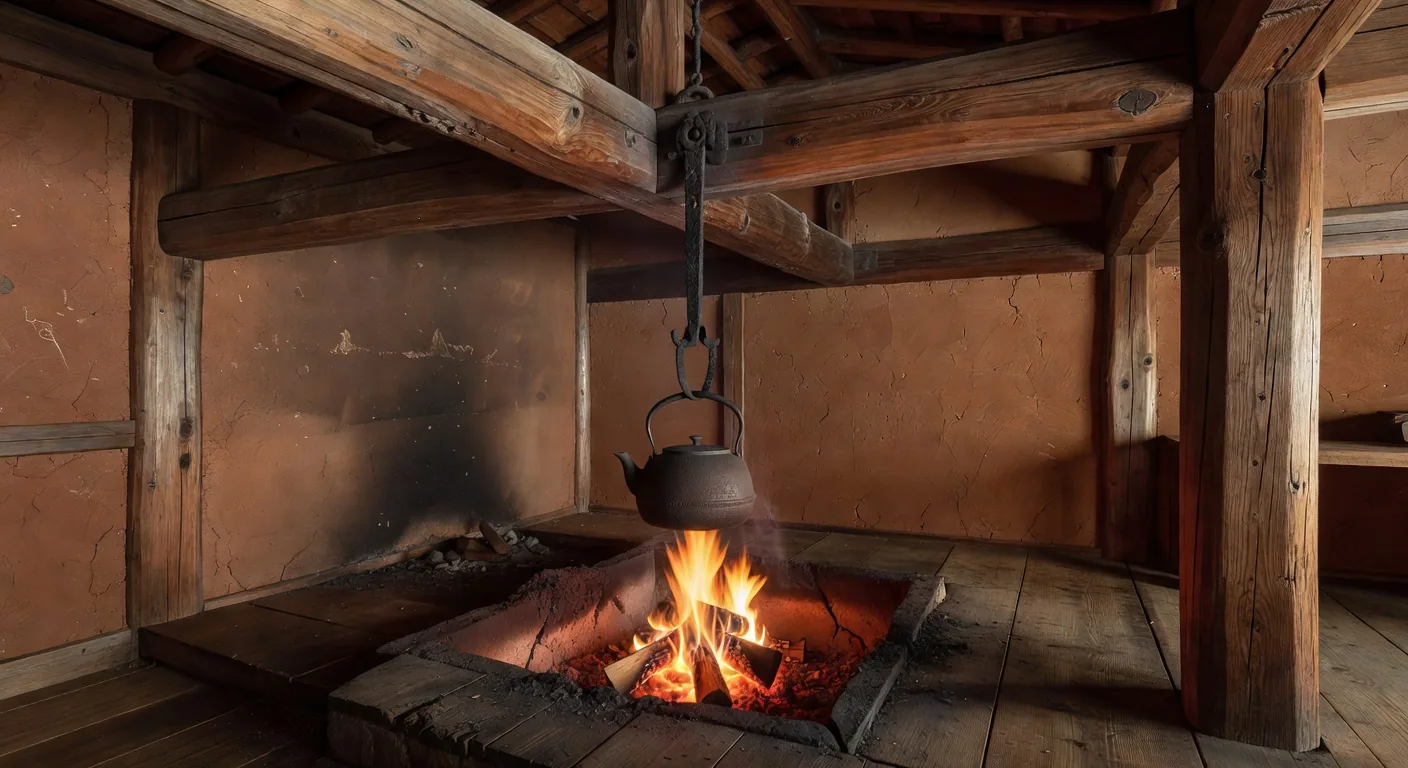
The preservation of building exteriors is relatively well understood and legally supported. Interior preservation presents far greater challenges: the same daily use that keeps a building alive inevitably alters its surfaces, fittings, and atmosphere. Smoke-blackened irori hearths, worn tatami borders, and patinated shoji paper represent centuries of accumulation that no restoration can authentically recreate.
Interior preservation philosophy in Japan increasingly favours authentic maintenance over reconstruction. Where elements have been lost, conservative documentation and minimal intervention are preferred to speculative recreation. Where original elements survive — even in compromised condition — they are retained and stabilised rather than replaced.
The irori hearth occupies a special place in this discourse. At the functional and symbolic heart of the farmhouse, the hearth was the source of heat, the site of cooking, and the focus of family gathering. Its smoke-blackened superstructure — a centuries-long accretion of soot and resin — acts as a natural preservative for the timbers above. Cleaning would destroy irreplaceable evidence.
Key Players
The national body responsible for designating and overseeing all protected cultural properties. Administers grant programs for restoration of nationally designated buildings and manages the national register of cultural assets.
The Japanese national committee of the International Council on Monuments and Sites. Bridges Japanese conservation practice with international standards, advises on World Heritage nominations, and promotes cross-border knowledge exchange.
A network of architects, historians, and craftsmen conducting detailed surveys of threatened traditional buildings and developing technical guidance for their restoration. Publishes documentation standards used across the sector.
Hundreds of community-based non-profits across Japan undertake the hands-on work of identifying threatened buildings, matching them with interested owners, securing funding, and organising the community engagement that sustains preservation long-term.
Current Issues
Traditional Japanese building techniques — thatching, earthen plastering, timber joinery, urushi lacquerwork — require decades of apprenticeship to master. The average age of qualified traditional craftsmen now exceeds sixty-five, and too few young people are entering these trades. Without skilled craftsmen, designated buildings cannot be properly maintained regardless of funding availability.
Authentic restoration requires authentic materials: old-growth timber of specific species and dimensions, locally sourced thatching grass, traditional mineral pigments, handmade washi paper, specific grades of clay for earthen plaster. Many of these materials are no longer commercially available in sufficient quantity or quality. Sourcing appropriate materials for major restoration projects now requires years of advance planning.
Traditional buildings are expensive to maintain relative to modern construction. Owners — often elderly, often with limited income — face repair bills that can exceed the market value of the property itself. Rural depopulation leaves many historic buildings without any viable use. Urban land values create constant pressure to demolish and redevelop. Without economic models that make preservation financially viable, legal protection alone cannot succeed.
What Works
The hamlet of Kayabuki no Sato in Miyama, Kyoto, contains over thirty surviving thatched farmhouses — one of the largest concentrations remaining in Japan. The community successfully lobbied for Important Preservation District designation, which enabled coordinated maintenance subsidies and strict development controls. Annual communal thatching events now attract volunteer participants from across Japan, helping address the craftsman shortage while building community investment in preservation.
38 thatched roofs preservedKanazawa's municipal government established a pioneering machiya registration and subsidy system that has transformed the city's historic townhouse stock. Over 200 machiya have been registered; of these, more than 140 have been restored using public subsidies and converted to cafes, galleries, guesthouses, and small offices. The programme has generated significant tourism revenue while preventing demolition of an irreplaceable urban fabric. It has become a model adopted by municipalities across Japan.
140+ buildings restoredThe designation of Shirakawa-go's gassho-zukuri farmhouse villages as UNESCO World Heritage Sites in 1995 transformed global awareness of rural Japanese architecture. The sites attract over one million visitors annually, generating revenue that directly funds roof maintenance. The designation also catalysed a successful living-heritage model: residents continue to occupy and work the farmhouses, ensuring that the buildings remain functional rather than becoming museum pieces.
UNESCO World Heritage 1995Get Involved
Preservation is not the work of governments and specialists alone. Individual engagement — through volunteering, responsible tourism, financial support, or simply raising awareness — makes a real difference to whether these buildings survive.