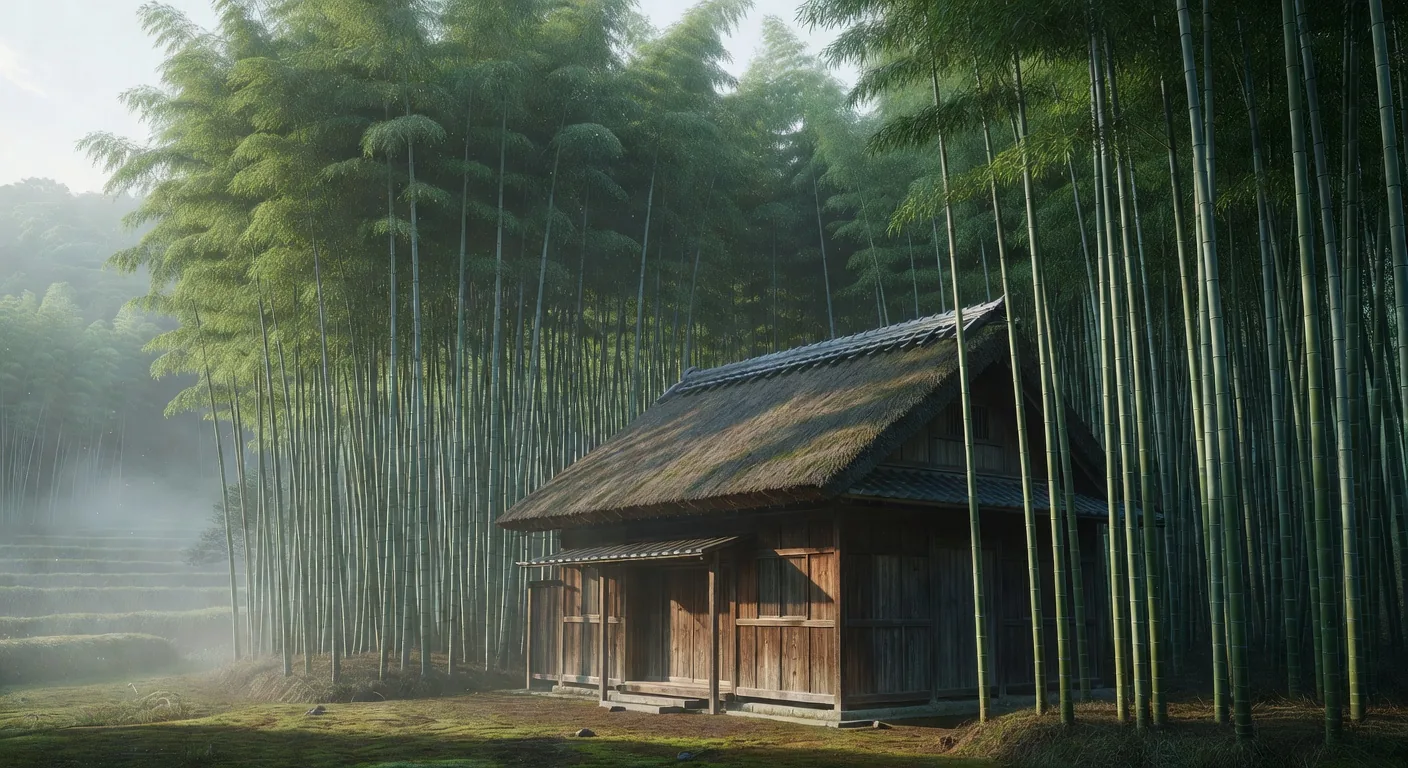
里山
Rural Japan — Architecture of the Land
Where the landscape shaped every beam, roof, and threshold
Where the landscape shaped every beam, roof, and threshold
Introduction
Japan's rural architecture represents humanity's most eloquent conversation with landscape. Scattered across mountain valleys, coastal terraces, and island plains, these structures grew not from abstract design principles but from intimate knowledge of local climate, available materials, and the rhythms of agricultural life.
For centuries, farmers, fishermen, and craftsmen built homes that were inseparable from their surroundings. Thick thatched roofs shed mountain snow; deep eaves moderated coastal humidity; raised floors allowed airflow in tropical southern islands. Each region developed its own architectural dialect — intelligible to the trained eye yet distinct in character.
The concept of satoyama — the boundary zone between mountain wilderness and cultivated lowland — profoundly influenced how rural communities placed and oriented their homes. Buildings were not imposed on the land but negotiated with it, their axes aligned to capture winter sun and deflect summer storms.
Today, fewer than 3 million people live in Japan's designated rural zones, down from a peak of over 15 million in the early twentieth century. The architectural heritage they leave behind is extraordinary: a living record of sustainable building practice accumulated over a millennium.
Regional Character
Japan's geography — mountainous, long, and climatically varied — gave rise to strikingly different regional building traditions, each adapted to local conditions, materials, and cultural influences.
Northern Honshu's harsh winters produced the magariya — an L-shaped farmhouse that sheltered both family and livestock under one roof. The elbow joint where humans and animals coexisted provided mutual warmth and allowed winter chores without venturing outside. Heavy timber frames, deeply pitched thatched roofs, and earthen walls characterise this stoic regional tradition.
The steep-sided valleys of Gifu and Toyama gave us the iconic gassho-zukuri — "praying hands" farmhouses whose steeply pitched roofs reach sixty degrees to shed Japan's heaviest snowfalls. The expansive roof interior housed silkworm cultivation; the ground floor accommodated extended multi-generational families. Now a UNESCO World Heritage Site, Shirakawa-go preserves this tradition in living form.
Warmer and wetter than northern Japan, Kyushu's rural homes emphasise ventilation over insulation. Wide verandas, latticed walls, and elevated floors allow sea breezes to pass freely. Many farmhouses here feature tile roofs rather than thatch — a southern influence from the Ryukyu Kingdom. The nagaya-mon long gate-house, common in Saga and Fukuoka, displays a courtly aesthetic unusual in rural contexts.
Shikoku's mountainous interior and isolated valleys preserved building traditions that disappeared elsewhere centuries ago. The kaya thatching here uses local sedge grasses of exceptional quality, and roof replacements remain community events — yui cooperative labour — that gather dozens of neighbours. Stone footings and fieldstone retaining walls integrate Shikoku homes into their terraced hillside contexts with particular grace.
Japan's northernmost island was largely settled in the Meiji era, producing a hybrid vernacular that blended Ainu spatial traditions with Japanese timber construction and, later, Western influence. Early settler homes reflect a practical urgency — speed and warmth above all — while later farmhouses show a distinctive Japanese-Western fusion with bay windows and Western-influenced pitched roofs alongside tatami rooms and traditional kitchens.
The Ryukyu archipelago's tropical climate, typhoon exposure, and distinct Ryukyuan culture produced an architecture entirely unlike mainland Japan. Low stone walls of ryukyu limestone surround compounds; coral-stone hinu'kan kitchen shrines anchor every household. Red roof tiles — akagawara — are sealed with shisa guardian figurines. The traditional fukugi tree windbreaks lining Okinawan village lanes form living architecture as essential as any building.
Climate Response
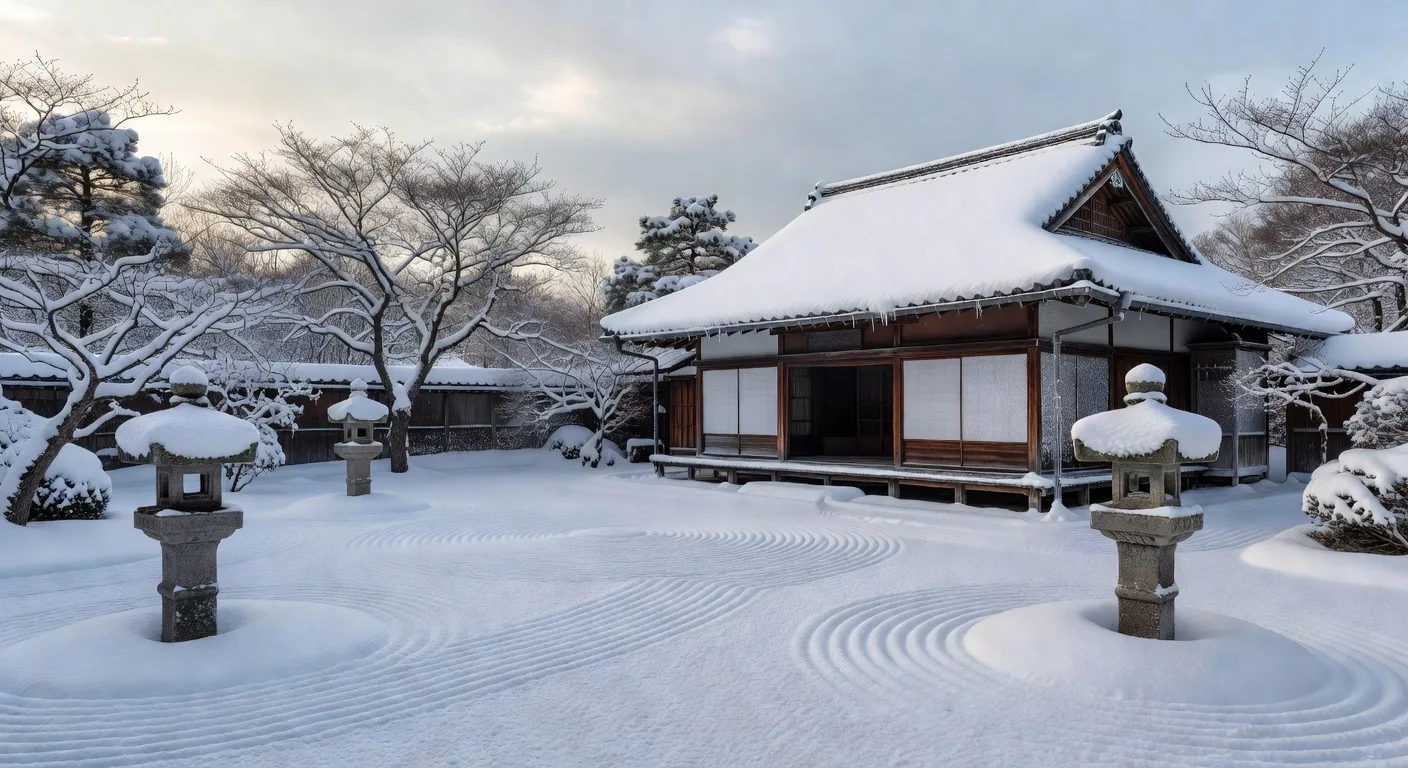
Japan's "Snow Country" — the mountainous interior of Honshu facing the Japan Sea — receives some of the world's heaviest snowfall. Rural architects here developed sophisticated responses over centuries: roofs that shed loads before they accumulate, floor systems that resist frost heave, and community planning that enables winter passage between homes.
Community Planning
Rural Japanese villages were not collections of isolated homesteads but tightly interwoven communities in which spatial organisation reflected and reinforced social hierarchy. The headman's compound — invariably the largest, oldest, and most prominently situated — anchored the settlement. Secondary families of long standing occupied the next tier, their homes slightly smaller but similarly gated and walled.
Water was the organising principle of most lowland villages. Satoyama communities situated themselves at the interface of forest and paddy, with homes strung along the contour line where foothills met flat farmland. This placement maximised access to mountain water sources while keeping prime agricultural land free of construction.
Communal infrastructure — the village granary, the communal well, the yui cooperative work yard — was positioned to serve all households equally. Shrines and temples occupied elevated ground, their visual prominence reinforcing their social importance. Even the direction a gate faced was subject to community negotiation, as unfavourable orientations were believed to bring misfortune to neighbours.
The ie system of extended family organisation found its physical expression in compound planning: main house (omoya), detached kitchen building, storage warehouses, and sometimes a separate retirement cottage (hanare) formed integrated ensembles that could house four generations simultaneously.
Working Architecture
The Japanese farmhouse was not merely a dwelling but a productive unit. Every architectural decision — orientation, floor height, roof material, outbuilding placement — was made in relation to the farming calendar and the physical demands of rice cultivation, sericulture, or fishing.
The large earthen-floored doma at the heart of every farmhouse served as the interface between outdoor agricultural work and domestic life. Here tools were maintained, produce processed, animals tended in winter, and crafts practiced on rain days. Its packed earth surface — sometimes treated with lime or seaweed ash — was swept but never truly clean, acknowledging the indivisibility of farm and home.
The detached storehouse, or kura, was as important as the main dwelling. Built with thick clay-plastered walls and minimal windows, it maintained stable temperature and humidity for rice stocks, seed grain, and family valuables. In prosperous farming communities, the number of kura a family owned was a direct index of their wealth and status within the village hierarchy.
Thatched roofs were not passive coverings but living agricultural systems. Layers of rice straw, kaya grass, or miscanthus were managed on a multi-decade cycle. The deep interior of the roof space provided essential ventilation for drying silkworm cocoons, hanging harvested tobacco, or curing root vegetables. The thatch itself, once removed at replacement time, was composted into the paddy fields as fertiliser.
Rural homes incorporated sophisticated water management systems that blurred the boundary between building and landscape. Stone-lined channels — mizube — ran beneath kitchen floors, providing cold running water for food storage and washing. Overflow fed vegetable gardens; overflow from gardens fed paddy margins. The entire compound functioned as a node in a larger hydrological network that shaped the surrounding terrain over centuries.
Current Status
The condition of Japan's rural architectural heritage reflects the demographic pressures and economic changes that have reshaped the countryside over the past half century.
Further Reading